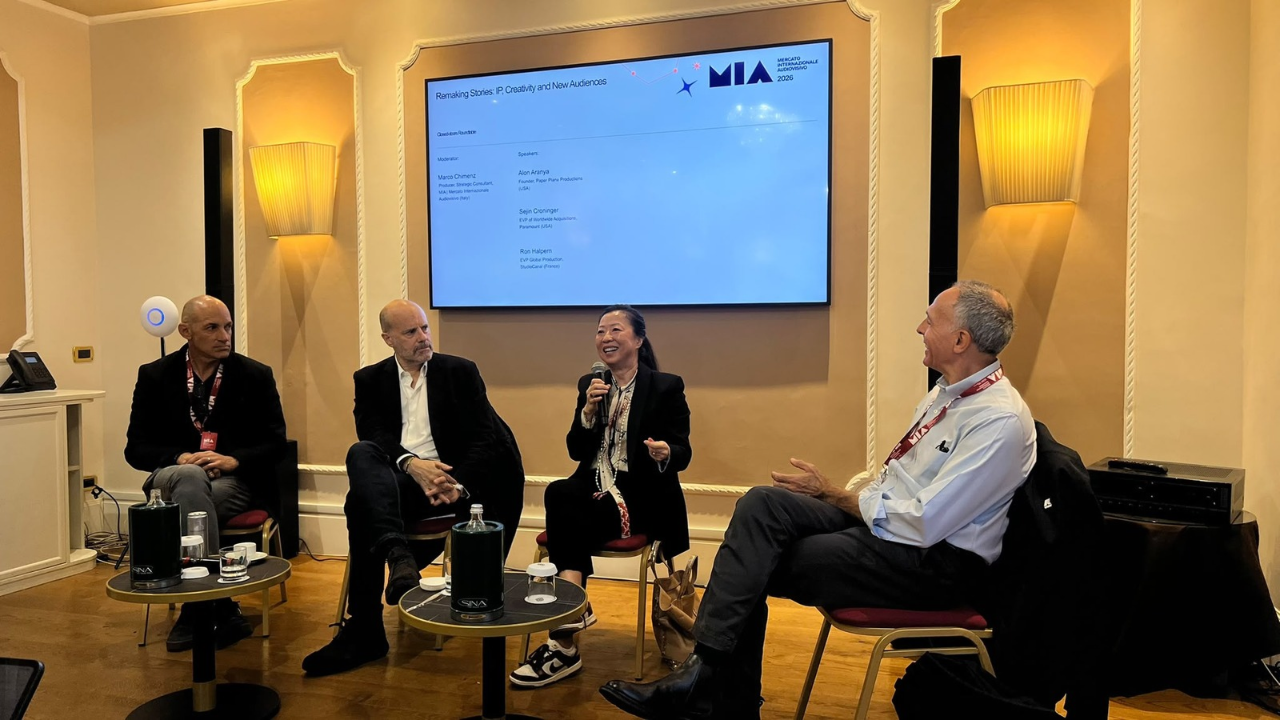
Today, the panel “Remaking Stories: IP, Creativity and New Audiences” took place at MIA, moderated by Marco Chimenz, Strategic Content at MIA.
The speakers included Alon Aranya (Founder, Paper Plane Productions, USA), Senji Croninger (EVP of Worldwide Acquisitions, USA), and Ron Halpern (EVP Global Production, STUDIOCANAL, France).
The panel provided an opportunity for industry professionals to network and exchange views on remakes and the legal and business affairs issues involved in bringing these projects to fruition.
The speakers discussed various projects produced by their respective companies, referring to In Treatment, The Office, and the more recent For Honor, starring Bryan Cranston.
The process of remaking a film or adapting a book is a lengthy one. Production companies must navigate a series of specific legal and financial steps to bring a project to completion.
When adapting books, an option agreement is generally signed, allowing a production company to secure the right to develop a film or television series based on the original work. Only at a later stage, when the option is exercised, are the rights transferred under the terms agreed upon with the author. Production companies often sign multiple option agreements for different projects, although many of these never make it into production.
Other issues concern commercial rights, which are handled by business affairs departments. These involve the management of intellectual property (IP) and also encompass co-production agreements and international partnerships.
The discussion also highlighted Follemente, a recent Italian success that has also been distributed on Disney+. Directed by Paolo Genovese, the film has attracted interest from international markets, with requests for remakes in other countries. Its trajectory echoes that of Perfect Strangers, Genovese’s 2016 film, which achieved box-office success and inspired numerous international adaptations.
The panel shed light on the legal and financial complexities involved in producing remakes, focusing on rights management and negotiations between producers and intellectual property owners.
It also highlighted the importance of adapting stories to different international markets while preserving the distinctive elements of the original work and enhancing their appeal to reach new audiences.



