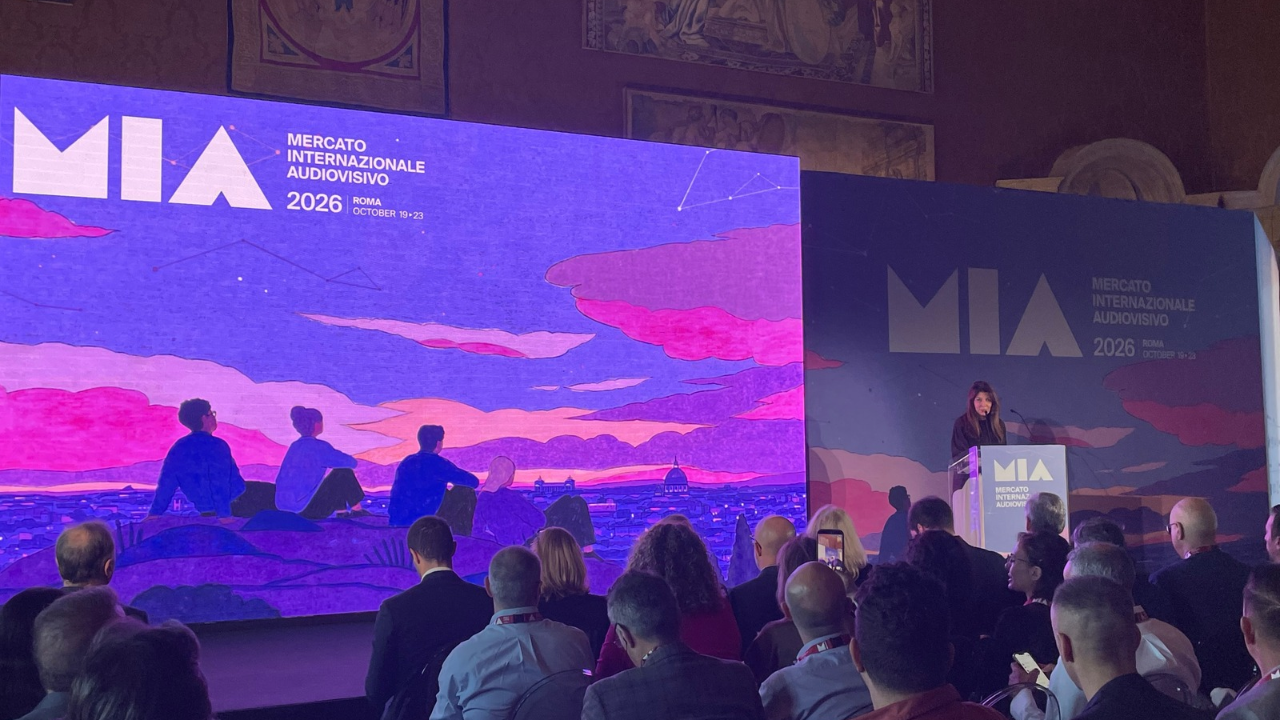
The twelfth edition of the MIA – Mercato Internazionale Audiovisivo opened at Palazzo Barberini. The event kicked off in the magnificent setting of the Sala Pietro da Cortona with the presentation of the European Investment Hub (EIH), a programme designed to take a closer look at the evolution of financial instruments dedicated to the audiovisual industry.
Following the institutional greetings by MIA Director Gaia Tridente, APA President Chiara Sbarigia and ANICA President Alessandro Usai, the discussion got underway, outlining the economic, legal and industrial trajectories of the Italian and European markets.
The first session on the programme was “European Financing Tools and Strategic Perspectives”, dedicated to financial instruments and strategic outlooks for the European audiovisual sector.
The talk highlighted how Italy has always been a key hub for the international audiovisual industry and how MIA represents an important opportunity for professionals in the sector to meet and connect.
A clear message emerged from the day’s discussions: growing the sector requires more than financing individual productions; it is essential to strengthen the entire industrial ecosystem.
Giuseppe Abbamonte, Director for Media Policy at the European Commission in Brussels, focused on the role of the European Investment Hub, an important initiative aimed at strengthening European companies’ ability to attract private capital and maximise the value of their content, at a time when Europe’s market share has fallen by eight percentage points and some strategic tools, such as graphics engines, are owned by non-European companies.
As Antonio Stefanucci, Senior Mandate Manager at the European Commission, pointed out, public support—which currently accounts for approximately 55% of the resources allocated to the sector—remains essential to attracting private capital and supporting creativity, particularly in a complex geopolitical context. This point was echoed by Charlot Appelgren, Secretary General of CineRegio, who highlighted the importance of co-productions and synergies between regional and European funds in turning local stories into competitive assets on a global scale.
The role of the audiovisual sector as a strategic tool for international promotion was at the heart of the contribution by Lorenzo Galanti, Director General of ICE – Italian Trade Agency. Galanti described the sector as a form of soft power capable of promoting Made in Italy around the world, emphasising how the European Investment Hub represents a tangible bridge connecting Italian SMEs with international investors.
On the public policy front, Giorgio Carlo Brugnoni, Director General for Cinema and Audiovisual at the Italian Ministry of Culture (MiC), stressed the need to support companies throughout their entire life cycle, ensuring financial sustainability, investment in young people through film education, and strong international cooperation, as demonstrated by the recent working group launched with France.
Along the same lines, Enrico Vannucci, Deputy Executive Director of Eurimages, outlined the support mechanisms and grants available for co-productions, also drawing attention to the pilot programme dedicated to TV series, designed to protect independent producers in their dealings with major streaming platforms.
Finally, Federico Eichberg, Chief of Staff at the Ministry of Enterprises and Made in Italy (MIMIT), emphasised that every major production requires a solid economic and financial structure. Referring to the Made in Italy supply chain strategy, Eichberg suggested exploring models of cooperation and collaboration—both thematic and territorial—to build critical mass, bring Italian expertise together and enable companies in the sector to compete effectively in international markets.



